
Become a
biomechanics expert yourself
The biomechanics training course is aimed at trainers, physical therapists, doctors, and other professionals. People who would like to pursue such a career path can also complete the training. It is based on practice, practice, practice. We are convinced that only applied, interconnected knowledge is real knowledge and leads to real skills.
We believe in knowledge transfer from person to person. That's why we place great importance on supporting the learning process. You will never be left alone with your questions.
You will be able to understand human movement as a system of biomechanical processes and learn tests and techniques that you can use to assess and improve your athletes' condition within the process.
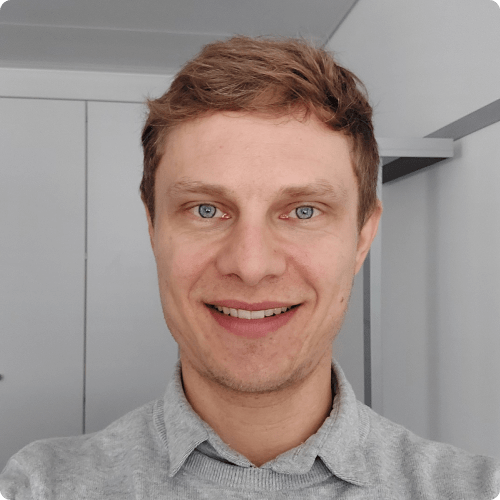
Graduate Julian
"Thanks to my fundamental understanding of the biomechanics of the human body and training theory from my training with Alexander Schenk, as well as my own experience in various sports, I am able to understand the problems many athletes face, solve them sustainably, and accompany them on their path to success."
Julian is also part of Alexander Schenk's team and helps look after our clients.
Practical biomechanics training
for personal trainers and fitness trainers
Module 1
Basic training in biomechanics and anatomy
The training lasts six months and requires 2–3 hours of focused learning per week + 1 hour of online sessions per week, during which the material learned is reviewed together. These online sessions take place with all other learners in Module 1.
It is taught in stages and includes:
- Foot + ankle joint
- Hip + Knee
- spine
- Shoulder blade + upper arm
- Forearm + wrist
Learn a deep understanding of anatomy and biomechanics
Learn about the bones, muscles, nerves, tendons, and ligaments of the musculoskeletal system and understand how they interact during human movement. You will learn about the possible degrees of freedom of human joints and which muscles execute, stabilize, or inhibit them. After passing the exam, you will be able to list every single muscle in the order of its activation for every movement you can imagine.
Certificate:
After successfully completing the basic course, you will receive a certificate confirming the knowledge and skills you have acquired.
Module 2
Biomechanics of sports / Analysis
The knowledge you acquired in Module 1 will be applied to different sports in Module 2. We will examine the basic principles of human movement in the context of various movement disciplines. You will learn why injuries and complaints occur more frequently in certain sports and how you can counteract them.
Biomechanical analysis forms the core of the module. It is the central tool for assessing and monitoring a person's condition and progress.
The following sports are considered:
- ball sports
- martial arts
- ballroom dancing
- water sports
- winter sports
- track and field
- gymnastics
- extreme sport
- motor sports
- cycling
- Fitness and weight training
- recreational sports
Module 3
training control
Learn how to select appropriate exercises for each context and calculate intensity, frequency, and volume. You will learn to distinguish between the interaction of fatigue at the nervous system level and at the nutritional level and to adapt training recommendations to these parameters. This module can only be completed after successfully completing modules 1 and 2.
The module is taught in stages and covers:
- Exercise theory
Training with external loads:
Long and short barbells, bands, training with body weight
- Tone regulation through:
- massage
- stretching
- Nervous system recovery through regenerative measures
- Process evaluation and control of athletic development within the sports considered in a competitive context
- Athletic periodization in interaction with the athlete's core sport
- Tone regulation in the context of periodization
Module 4
Advice on pain
Module 4 deals with the connection between biomechanical problems and pain. It teaches participants to identify the cause of pain using the biomechanical analysis techniques they have already learned. Graduates will be able to recommend appropriate measures based on biomechanical analysis to help those affected return to a pain-free life.
The Pain Management module is based on four key topics:
- Biomechanics Diagnostics
- Load management in the context of time
- Limits of biomechanics – When should experts from other fields be consulted?
- Systemic causes and psyche
Module 5
Case studies
Case Studies Pain
Over the past few years, we have recorded online sessions with the athletes. As a group, we will look at a variety of case studies and discuss how the problem of the person affected could be solved. During this exchange and consultation, the video will be paused. The group can then watch the solution to the problem together, and afterwards we will discuss why the person's pain has disappeared and which biomechanical processes led to this.
Case Studies Athletes
Together, we will look at the development of athletes over a period of several years. Participants in the module will gain insights into the development of athletic performance in the context of periodization and injury prevention. Graduates of the module will be able to successfully plan and support athletic development over 5-year periods.
Module 6
How to do business
Module 6 can be completed independently of the biomechanics training course. It is aimed at people who plan to become entrepreneurs in the world of sports.
As in the other modules, we place a strong emphasis on practical application. Graduates of the module receive support from the business registration stage through to the market launch of their product or service. Our team of lawyers, marketing specialists, and entrepreneurs imparts knowledge while ideas are put into practice. This allows the knowledge learned to be optimally networked while real-world experience is gained. The module is therefore tailored to the needs of each individual graduate. A maximum of three training places are available for Module 6 at any one time.
Arrange a no-obligation initial consultation with
now
Contact
Alexander Schenk
E-mail: info@alexander-schenk.eu
Tel.: 0170 475 8907
Wilhelm Maybachstraße 31/1 Entrance D
72108 Rottenburg am Neckar